
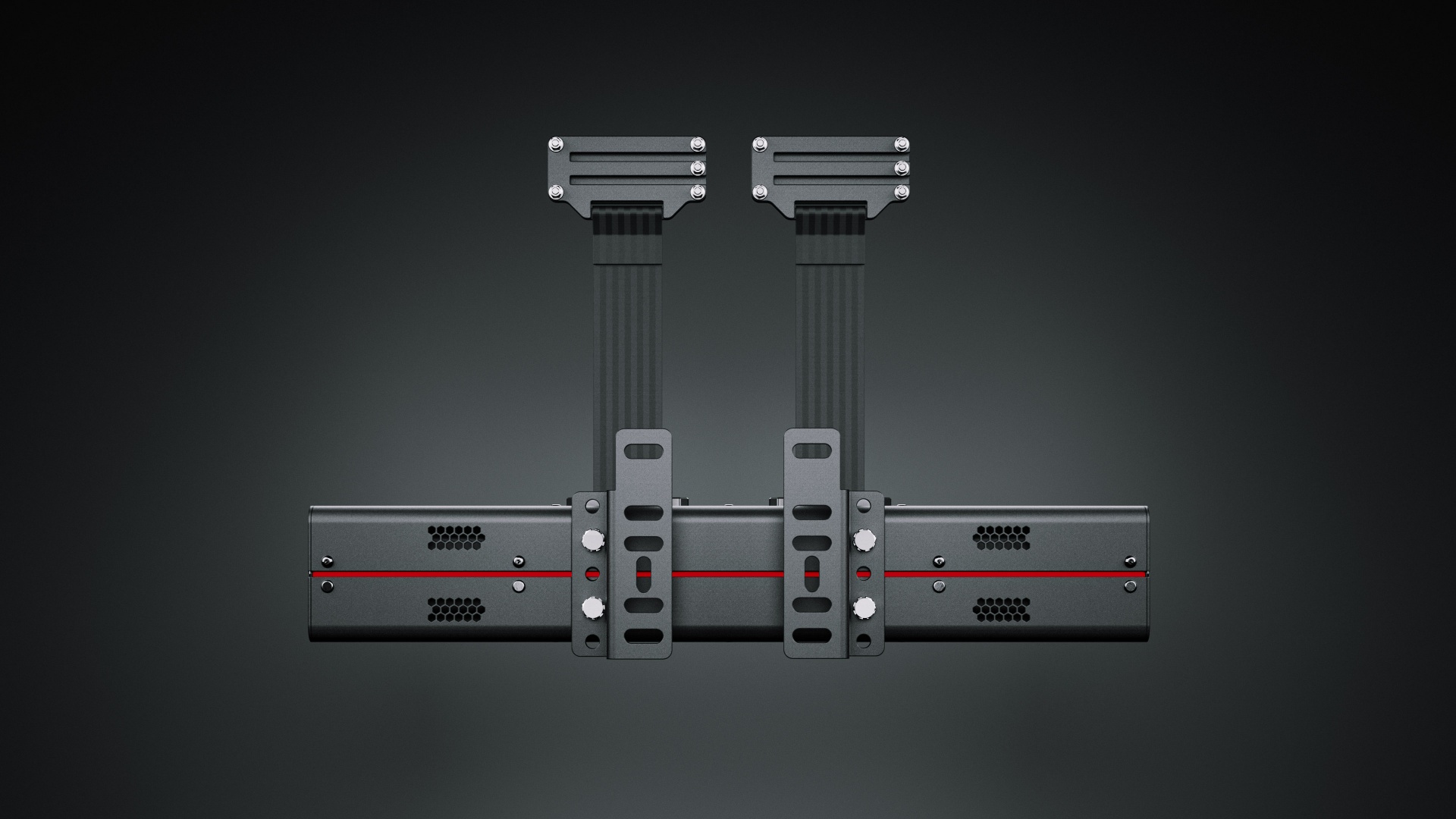
QS-BT1 hero
Showing media for QS-BT1QS-BT1
King of the entry-level immersion
Drivers who want immediate, body-felt G-force, braking and traction-loss cues — with or without a motion platform.
Specified, installed and supported by Forrest Motorsport. Pricing, availability and lead times confirmed on enquiry.
See the QS-BT1 belt tensioner in action
Watch the QS-BT1 demonstrate how dual-channel belt tensioning adds physical braking force, cornering load and motion feedback to a simulator setup.
Paste a YouTube URL into YOUTUBE_VIDEO_URL in QSBT1VideoSection.tsx to enable playback.
QS-BT1 Dual Channel Belt Tensioner
The QS-BT1 is a dual-channel direct drive seat belt tensioner designed to increase simulator immersion by applying independent force to the left and right shoulder straps.
- ›Powerful braking force simulation
- ›Independent left and right shoulder tension
- ›Lateral cornering feedback
- ›High-speed cornering sensation
- ›Wheel lock and traction loss feedback
- ›Compatible with QS motion platforms
- ›Suitable for standalone use and selected third-party platforms
- ·Braking G-forces
- ·Lateral acceleration
- ·High-speed cornering
- ·Wheel lock and traction loss
- ·Positive and negative G-forces
- ·Banking and roll sensation
- ·Speed brake deceleration
- ·Cannon fire and missile launch feedback
Product card opens as a PDF.
Why add belt tensioning?
A belt tensioner adds physical load through the seat belts, helping the driver feel braking, cornering and motion cues through the body rather than only through the wheel, pedals or motion platform.
Feel the belts tighten under hard braking.
Independent left and right channel control helps simulate cornering load.
Adds another layer of feedback to motion, cockpit and dashboard systems.
Driven by the same direct-drive technology as the flagship QS-220, the QS-BT1 is a multipurpose, dual-channel seat belt tensioner that delivers 200 N of pulling force per channel with just 8 ms of latency. It recreates braking, lateral and centrifugal loads, wheel slip, gear-change, engine vibration and pre-impact protection — and with 41 kg / 90 lbs of sustained pull across both channels, it is equally at home in flight sims, where it lets you genuinely feel sustained G-loads. Designed to complement direct-drive wheels and Qubic motion platforms, or to stand alone as an immersion upgrade on a static rig.
Feel Every Stop
QS-BT1 significantly raises the realism of braking, letting you deeply engage with the intricate dynamics of decelerating a real car. The two channels pull through the harness in perfect sync with the telemetry — turning every threshold-braking zone into a physical event, not just a number on a wheel.
Advanced Steering Simulation
With two independent channels of direct-drive tension, the QS-BT1 can pull asymmetrically through the harness — letting you feel cornering load shift across your shoulders. Subtle reactions through the seat belt sharpen your awareness of grip, slip-angle and weight transfer, just like in a real car.
Feel the Engine
Innovative engine-vibration effects translate revs, rev-limiter hits, road harshness and gear changes into pulses you can physically feel. Effects are precisely tuned to dynamic acceleration and gearshifts, so a downshift into a hairpin lands with the weight you'd expect from the real car.
Flight-Sim Ready
With 41 kg / 90 lbs of sustained pulling force across both channels, QS-BT1 lets you experience the difference between 1 G, 3 G and 9 G in the cockpit of a jet. Positive G, negative G, centrifugal load through a roll, cannon fire, missile launch and flare dispose — all faithfully reproduced through the harness so the gap between sim and reality gets smaller again.
Plays Well With Your Rig
QS-BT1 is compatible with every motion platform powered by Motion Systems technology (QS, PS and HS) and integrates natively with ForceSeatPM / Qubic Manager. Run it on its own as a serious immersion upgrade to a static cockpit, or layer it on top of a QS-210, QS-220 or QS-V20 / QS-S25 for a complete head-to-toe sensation.
"Takes the immersion to a whole new level."
Motion must be tightly synchronized with telemetry — anything noticeably delayed simply feels wrong. Professional systems operate below 15–20 ms from input to physical motion. QS-BT1 reacts in 8 ms. For context: a Formula 1 driver reacts in ~165 ms, an F-16 pilot in ~172 ms, the average human in ~247 ms. The belt has already started pulling before your brain has registered the brake light.
Set Up the Seat Right
- ›Belt slots should align horizontally with your shoulders — that's the correct height for honest racing feedback.
- ›Slots above shoulder level reduce realism and dull the feedback.
- ›Slots below shoulder level pull downward — useful for flight sims to mimic vertical G, but wrong for racing.
- ›Optimal width: belts pass directly above the shoulders without touching the neck.
- ›Slots set too wide cause unnatural outward shoulder pull. Slots set too narrow concentrate force on the chest and can cause discomfort or injury.
Designed to Be Pushed — Safely
- ✓Motor and power-supply pairing is tuned to balance pulling force with speed for safe operation.
- ✓Pulling force is strong enough for realistic sensations yet safe for the human body.
- ✓Dual-channel self-testing Motion-Lock system, compatible with QS motion platforms and QS-DD-20.
- ✓Additional software watchdogs add a second layer of protection beyond the hardware safeguards.
- ✓Near-silent operation — 24h endurance friendly, suitable for shared homes and late-night stints.
How fast
is 8 ms?
Test your reaction time
Motion must be tightly synchronised with input telemetry. If a platform reacts too slowly, immersion breaks — and discomfort may follow. Professional systems operate below 15–20 ms from telemetry input to actual physical motion. Anything noticeably delayed simply feels wrong.
That's why real-world latency matters. Play Qubic Reflex, test your reaction, and compare it to our 8 ms latency.
Check your fastest reaction time or measure consistency across 5 consecutive runs. Choose your control style: classic Click to React or Clutch Drop — hold and release.
Click the panel (or press Space) the instant the lights go out.
A Complete, Supported Install
- Specification matched to driver, room and budget
- Professional installation and cable management
- Plugin and software configuration
- Calibration and driver handover
- Ongoing service, upgrades and support
- Integration with chassis, seat, wheel and pedals